The story of SPACE for Play: A framework for building community at work, team connection and growth through structured play
Why play?
Play is an innate primary process emotion, baked into how we fundamentally function. Many things funnel through play, like learning, discovery, and emotional regulation, so when we are deprived of play, it can lead to depression and a lack of motivation. When was the last time you played at work? For real. Can you actually recall a recent time when you played at work?
If you can, consider yourself lucky.
For most teams, play is for kids, or a once in a while treat given by a trainer or facilitator just passing through. And then, it’s back to work…
Dr. Stuart Brown, founder of the National Institute for Play, emphasizes that “the opposite of play is not work—the opposite of play is depression.” Play is how we stay connected to ourselves and each other.
And yet, 68% of employees are disengaged at work. 84% of tech workers report burnout. Those aren’t just statistics. Those numbers represent people, like me, who love what they do but struggle to do it.
Play protects against depression, cynicism, and purposelessness. Sadly, I get the feeling that a lot of folks working in tech feel this way. But if you’re reading this, I hope it means you want to make a change. You want to bring back play to work. Work has been, can be, and should be playful.
If this is you, you’re in the right place! We can start weaving more play into our day to day and reaping the benefits. That’s why I created SPACE for Play.
What is SPACE for Play?
SPACE for Play is a framework for building safety, connection, and sustainable teams through games and playful methods. As a result, it improves engagement, connection, and skill growth on teams, all major issues facing tech teams today. It works by tapping into one of our most fundamental human abilities and needs–play. Over time, play creates a safe environment for teams to be themselves, connect, and engage through methods like traditional and digital games, imagination, and playful exercises.
I created it out of my own play-starved frustration, burnout, and purposelessness, based on my experiences as a UX designer, lifelong gamer, and facilitator.
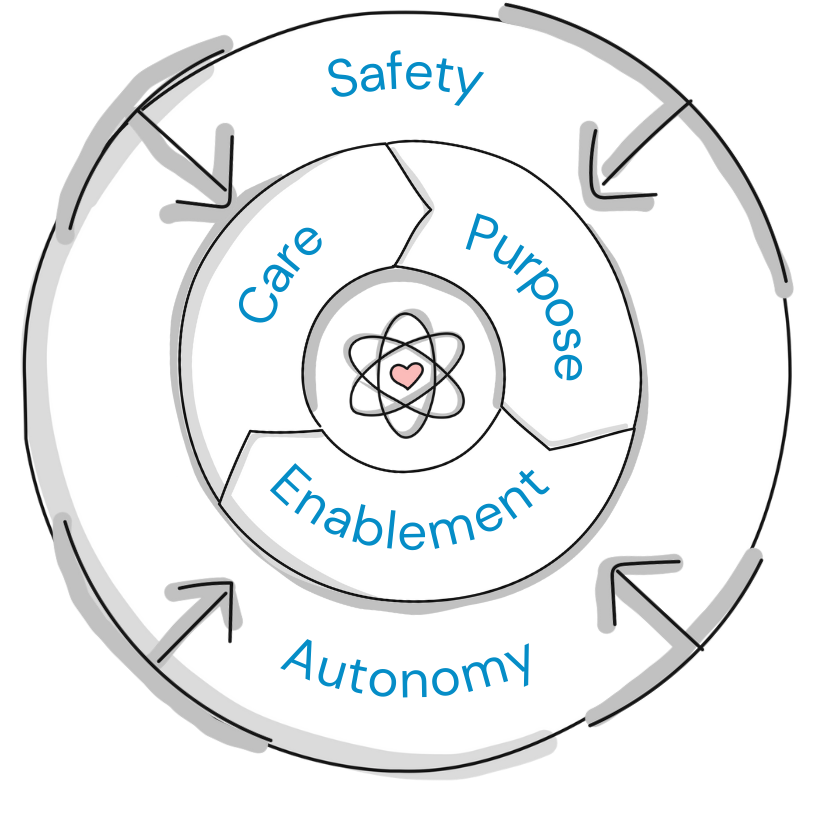
The framework is made up of 5 elements, each one a letter: Safety, Purpose, Autonomy, Care, and Enablement. SPACE is a fun way to remember each one.
A case study
I set out to understand: What actually creates happy, engaged teams?
I created a small online community where I could focus on the aspects of safety, play, and connection. I called it The Party, a wink and a nod to adventuring parties in role-playing games like Dungeons & Dragons, and party lobbies in multiplayer games. I defined “party” as: a chosen team, each on their own path, traveling together, learning, stumbling, supporting each other, and celebrating the journey, side by side.
It started with a few friends and grew to 14 members over 5 months, from July through November 2025.
Every day, I posted questions as an easy way to practice self-awareness, creativity, vulnerability, and other soft skills; a chance to share and get to know more about folks, take a moment to be present, daydream, be silly, and connect with other party members.
Questions like:
“Draw a fantasy sword using a post-it note. Tell us about its made-up background.”
“If your current project was a D&D character, what would it be?”
“Share your emoji mood for the week ahead.”
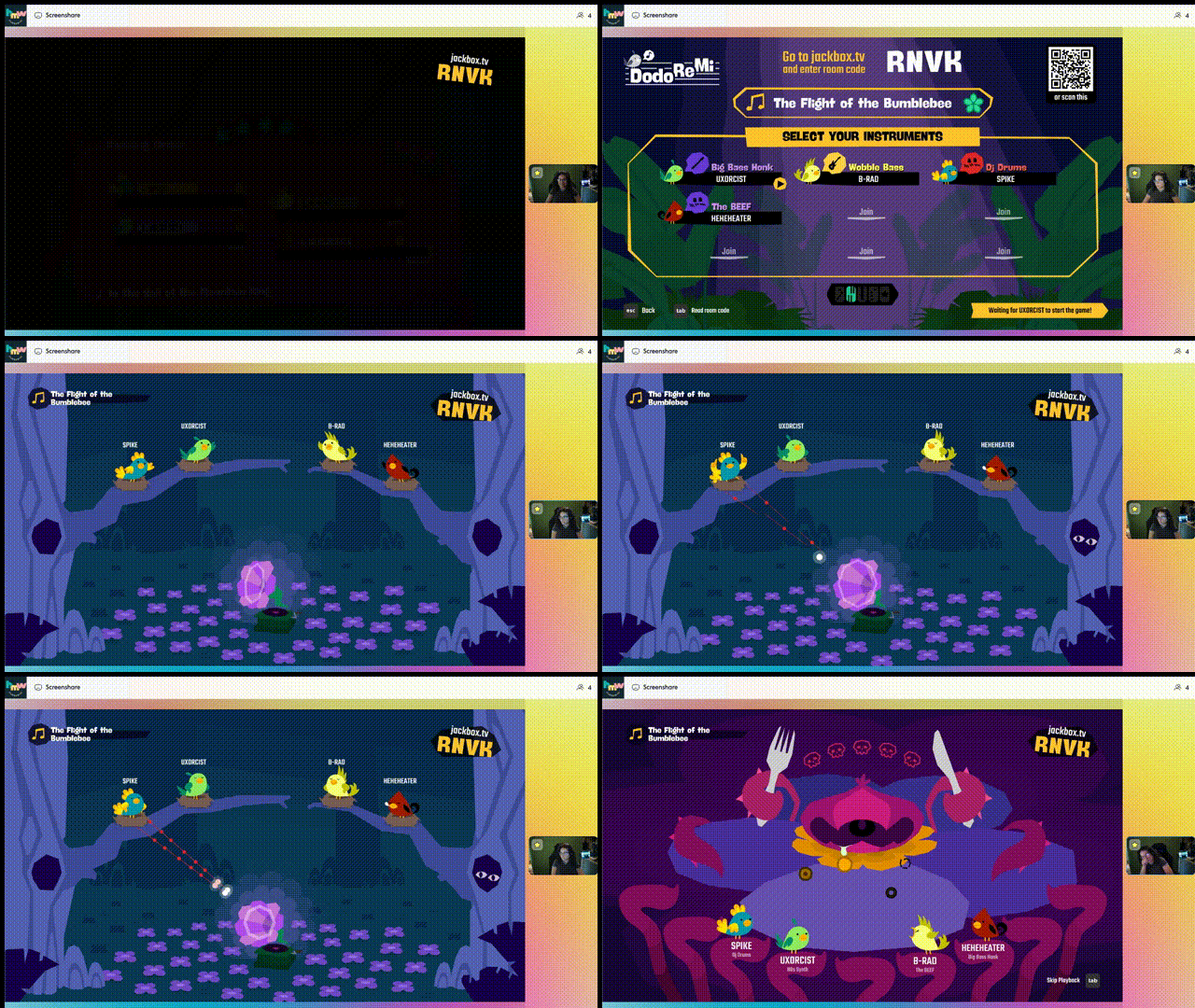
I hosted remote coworking sessions, a book club, and facilitated workshops on topics like questing for rest. And I created space for us to play together, make connections, and develop skills using digital, card, improv, and role-playing games. Think Jackbox games for creativity, This Discord Has Ghosts in It for storytelling, Keep Talking and Nobody Explodes for communication under pressure.
The data told a story…
After 5 months, party members reported a 74% improvement in their sense of connection, up from an average of 2.3/5 to 4.0/5. Party members improved in an average of 7 different soft skills.
- 78% reported more energy at work
- 70% felt less isolated
- 67% reported improved empathy and active listening
- 100% would recommend these methods to their teams
The stats proved it worked. But the testimonials showed me why it worked:
“I really enjoyed the safe place built for communication and community. I liked having a place where others understood the struggles of working environments and allowed me to express them in ways that wouldn’t affect my job.”
“Connecting with others and feeling less isolated or lonely. I really only talk to my family throughout the workday. During work, it’s just me alone at my desk for most of the day. It was great to be able to take breaks and connect with others going through the same things.”
“Using play that is fun and not like usual boring team building stuff like ice breakers and chicken, dog, boat scenarios! Those things have their place but they are out of touch and boring and could use a revamping.”
“Focus was on the play, not my effectiveness or productivity. Felt safer to be a bit vulnerable.”
The pattern I kept seeing
We had clear agreements about respect, accountability, and confidentiality. I invited people to participate however felt right, meaning cameras on or off, PJs or casual, all made up or goblin style, voice or text, early, late, or not at all. There would always be another session.
TL;DR: you do you, boo.
And what happened? It became the kind of culture I missed. The kind I wanted tech teams everywhere to experience. At the end of 5 months of events, community moderation, relationship building, running games, discussions, and workshops–oh my!–It clicked. I finally understood what made those happy, engaged teams work.
And I knew then exactly how I could help other teams connect, too.
Safety, Purpose, Autonomy, Care, Enablement
Safety
Work shouldn’t feel like a threat.
Did you know that the Surgeon General has a workplace wellbeing framework? The first essential is protection from harm.
Raising your hand in a team meeting shouldn’t make you feel like you’re being chased. Seeing an email come in from your boss shouldn’t stop you in your tracks. The best way to nurture a team environment away from dipping into our fight, flight, or freeze response is by creating psychological safety, this idea that you won’t suffer a loss, harm, or humiliation by speaking up, sharing an idea, or being yourself.
Studies find that psychological safety in teams is linked to higher engagement, lower stress, and lower turnover. Sounds nice right? That’s because safety is what lets people relax.
Once people feel safe, they need freedom to choose how–and if–they participate.
Autonomy
Choice makes engagement authentic
In The Party, we welcomed folks to engage however felt right. Some came ready to play fully. Others watched from the sidelines. Others didn’t participate at all, and that was okay.
Forced family fun. At one time or another, we’ve all had to participate in team building activities we had little to no interest in. And it’s very likely it didn’t bring out our best. It’s hard to be engaged when we don’t have the autonomy to engage in a way that feels comfortable to us. Nobody wants to be told to have fun.
Autonomy is about creating different ways for people to contribute in the ways that work for them, not just in traditional norms or whatever’s easiest. This is essential for diverse teams with neurodivergencies, ESL needs, disabilities, and simply, different communication styles and needs.
Safe, autonomous spaces allow people to care for each other.
Care
From coworkers to community
Care is about connecting to the people on your team. Most teams operate on a surface level. We know each other’s job titles, maybe responsibilities, or coffee/tea preference, but we don’t actually know–or care–about each other as people. How are you feeling? What’s scaring you this week? How can I help? In The Party, all our meetings started with check-ins.
The most caring teams seek to understand what each person on the team is feeling today, what energy they’re bringing in.
Eventually, teams that care begin noticing when someone’s off and checking in on each other. They recognize each other’s contributions and get comfortable leaning on each other when things get hard.
There’s a reason Gallup asks “Do you have a best friend at work?” in their engagement surveys. Of course, you don’t need to be best buddies with everyone to have care on your team. Just curiosity and compassion for each other.
Play can help by creating spaces for people to share parts of themselves beyond work, in an authentic way. A little playful structure can go a long way in making sharing feel safe. Play naturally gives folks a way to see each other as full on people, not just the professional versions they see every day.
Purpose
Playful goals
Now we’re ready for purpose, injecting fun and playfulness into everyday things like standups, retros, presentations.
We’re ready to participate in playful things because we remember how it felt to play as children. It felt safe, optional, and caring – a judgement-free zone to try things out and discover what works for you.
We can imbue our daily ceremonies, meetings, and activities–stand ups, one on ones, retros, etc–with playfulness to reach the same goals while leveraging our connections with each other and ourselves. We can do work while we play, and we can achieve more through play.
Play can make activities, like reflection, more fun and lowers the pressure in the room. This might look like asking the team to come up with the worst possible solution in a brainstorming meeting to start loosening up. It could be as simple as doodling on your boards or as involved as using full-on games to run a retro.
Purpose means play is intentional, helping the team with something they need, like connection, energy, or brainstorming.
Enablement
Enter the magic circle
The last element is enablement: using structured play to develop specific soft skills.
In 1938, Johan Huizinga established the concept of the magic circle in his influential work, Homo Ludens: A Study of the Play-Element in Culture. The magic circle is the idea that when we step into play, we enter a special space with its own rules that suspends our day to day consequences (Think: GTA, Call of Duty). In this space, we can practice things that feel risky in real life (but you know, more low key than Call of Duty!).
This is the backbone of enablement, using games to directly improve and grow the team through skills and connection. In essence, we’re using games to enable the team. Enablement uses structured gaming and play to help your team get better overall through practice in safe containers. It’s a way to build muscle memory together so that you have patterns to fall back on when, for example, actual team disagreements come up.
Each game creates a low pressure lab to practice difficult skills without work consequences.
The suspension of disbelief in the magic circle allows the team to immerse themselves in role playing games like Dungeons and Dragons or silly games like Jackbox. It makes it easier to be part of a team, find your communication style, and learn how to have conflict with the team. Why? Because the rules of reality don’t quite apply! What happens in fantasy lands, stays in fantasy lands.
For example, in The Party, we used For the Queen to practice collaboration and vulnerability. We used Peak for emotional intelligence and teamwork.
What’s next?
SPACE for Play isn’t strictly linear. Safety is an ongoing thing that needs to be tended to as much as any other element. Autonomy, care, and enablement feed into each other. The way you structure activities influence safety and choice. Purpose evolves as your team learns together and meaning/goals shift over time.
Since safety and autonomy are the foundation, if you have gaps to address, start with safety, even if it’s a small gap. You don’t have to wait for safety to be perfect though. Even on a team with low safety, you can start small with low risk interactions like short reflections, story telling, or collaborative problem solving. Model vulnerability and safety. Focus on creating predictable, positive experiences. Openly acknowledge limitations, mistakes or feelings. Add in structured exercises that normalize imperfection, like sharing one small win and one challenge from your week.
You can build trust by acknowledging effort, validating feelings, and showing follow through. Introduce playful elements little by little, first layering in some structure, like clear start and end times, turn taking, or basic prompts like “Share one thing you did this weekend in one word or less.”
Use choice as a bridge, letting people engage on their own terms and on their own timeline. Not everyone is going to be super interested in playing for the first time on a team that’s not always been safe. Consistently notice, reflect, and respond to individual and group needs. Celebrate the small moments of connection that emerge. Eventually, folks will gradually increase their comfort with risk.
The outcomes of SPACE for Play–connection, safety, engagement, and growth–are emergent; they show up when the elements are present and feeding into one another.
How I can help
Sign up for the newsletter below to get SPACE for Play tips and resources in your inbox.
How you can work with me now
- Take the free SPACE for Play assessment
- SPACE for Play Kickstart workshop
- Miro templates
—
Lissy is a UX strategist and facilitator who’s spent 10+ years integrating play into workshops, designing serious games, and leading teams to over 10 million in revenue. She created S.P.A.C.E. for Play by systematizing what she’s learned on tech teams then validating it through The Party, a 5-month experiment that helped 14 tech workers improve connection by 74%..